Friday, 3 June 2011

A quick look at the BlackBerry Torch 2


We've already seen the BlackBerry Torch 2 in photos courtesy of Mr. Blurrycam, but a little birdie from Negri Electronics was kind enough to send over a pre-release device for us to get under our own glass for a little photo shoot. Though it has a virtually identical form factor to the original, the Torch 2 bumps the specs in almost every department from the camera to the RAM. Oh, and it's running the next-gen BB OS 7 -- which is really OS 6.1, and still lacks any QNX DNA. Read on past the break for a full preview of this yet-to-be-announced slider, and some glorious HD video if the beautious shots aren't enough to whet your BBM-hungry appetites.


Read the full preview over at Engadget

Texas Instruments 1.8GHz dual-core OMAP mobile processor in the works

Texas Instruments on Thursday unveiled its latest mobile processor, the 1.8GHz dual-core OMAP4470, from the annual Computex trade show in Taipei, Taiwan. The new CPU is destined for smartphones and tablets, and it features a power-sipping design that offers a variety of performance enhancements compared to older processors. According to TI, the OMAP4470 will deliver an 80% improvement in Web browsing performance, a 250% improvement in graphics performance, up to 200% more layered imaging and video composition, and support for up to three HD displays and up to QXGA 2048 x 1536-pixel resolution. “Superior mobile computing relies on a user experience that dwarfs all others. Fast and crisp Web browsing, HD and liquid UIs, support for the latest applications—these are the elements consumers judge and buy their devices on,” said TI’s VP of the OMAP platform, Remi El-Ouazzane, in a statement. ”The OMAP4470 processor delivers the maximum experience possible with an unmatched, power-efficient architecture.” OMAP4470 samples will begin shipping to partners in the second half of 2011, with devices utilizing the chip expected to begin shipping in the first half of 2012. Hit the break for the full press release.


via BGR

Wednesday, 1 June 2011

A first look at Windows 8 for tablets


We're live from Microsoft Windows president Steven Sinofsky's keynote at D9, and there's something rather exciting on stage -- a pair of experimental Windows 8 dev boards running an OS that looks very much like Windows Phone 7's Metro UI. All Things D actually sat down with the man earlier today and got a sneak peek at what to expect starting with the live tiled screen you see above -- and yes, like Windows Phone 7, this OS is designed for touch.

There'll be two kinds of applications for Windows 8, one that runs in a traditional desktop, and the other pseudo-mobile apps based on HTML5 and Javascript, but both environments -- rather, the entire OS -- have been designed from the ground up for touchscreen use. Keyboard and mouse will still be options for both sets of programs, but there are multiple virtual sets of keys for different form factors, including a split keyboard for vertical slate use. Multitasking is simply a matter of swiping running apps into the center of the screen, and you can pull windows partway to "snap" them in place alongside other windows -- even mixing and matching traditional desktop programs with web apps simultaneously (like Twitter alongside your spreadsheet). There's a new version of Internet Explorer 10 (which runs Silverlight) and an app store built into the touchscreen interface, along with integrated services like Office 365. Microsoft says the new OS will run on laptops, tablets and desktops when it appears -- whenever that might be.


Continue reading via Engadget

Microsoft to acquire Nokia's Mobile division for $19 billion?


According to industry insider Eldar Murtazin, Microsoft has struck a deal to purchase Nokia’s mobile phone business for $19 billion. Just two weeks ago, Murtazin — who has a proven track record — suggested that Microsoft and Nokia were about to enter closed-door meetings to negotiate a possible purchase that could close sometime before the end of this year. It could make sense: Nokia’s CEO is former Microsoft executive Stephen Elop, and the two companies have already reached a deal to create new Windows Phone devices, a dozen of which are expected to launch next year. We’ll have to see how this pans out, but a Nokia spokesperson had already addressed Murtazin’s earlier claims, saying “Eldar’s rumors are getting obviously less accurate with every passing moment.”


via BGR

Why the Padfone might just be the future of mobile technology

Yesterday, ASUS revealed its Padfone, a mobile phone that can ‘dock’ into a tablet device to give it a larger screen, additional battery power and I/O ports.


Though ASUS might not have got it quite right, the Padfone is a step in the right direction and shows how in future you’ll only need a single phone which will plug into various docking systems to give you the functionality required. For example, a tablet for multimedia playback and a keyboard and larger screen for when you need a netbook.

Though the specs of the ASUS Padfone haven’t been released, the phone has a 4.3″ display and the tablet which it docks into is a 10.1″ unit.


Intel displays fleet of x86 tablets at Computex 2011


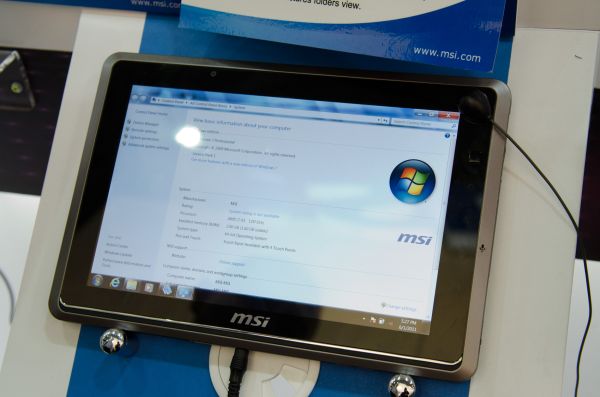
At the opening of the Computex Taipei 2011 trade-show, Intel Corp. demonstrated more than ten tablets based on the company's latest system-on-chip for ultra-portable devices. The tablets come from different manufacturers and utilize different operating systems, including Android, MeeGo and Windows. In addition, the company revealed some peculiarities about Medfield-based devices.
Sean Maloney, an executive vice president at Intel, demonstrated more than ten tablets from both own-brand manufacturers (Fujitsu, Lenovo, MSI, Toshiba, etc.) as well as contract makers of electronics (Clevo, Compal, ECS, Foxconn, Pegatron, Quanta, Wistron, etc.). All of the tablets are based on the company's Oak Trail platform featuring the Atom Z670-series microprocessors and utilize either Google Android 3.0 "Honeycomb", various MeeGo flavours as well as Microsoft Corp.'s Windows 7 operating system.

Continue reading the rest at Xbit Labs

Tuesday, 31 May 2011

Acer W4 Windows Phone Mango device spotted at Computex 2011


Microsoft announced the partnership with Acer to develop Windows Phone devices just last week. But it seems that they have been working even before the announcement, as at COMPUTEX event held today, Acer’s device W4 as kept under display running Windows Phone Mango.
Acer W4 Spces:
  • 3.6-inch WVGA Capacitive screen,
  • Screen Resolution: 480×800
  • 5mp Camera with auto-focus.
  • HSPA 850/1900 or 900/2100 /GSM quad band 850/900/ 1800/ 1900 MHz Support.
  • Qualcomm MSM 8255 running at 1GHz (same processor as in the Xperia Play)
  • Wifi, Bluetooth 2.1
  • DLNA Support
  • Windows Phone Mango
  • 8GB Storage

Microsoft will impose Windows Phone like hardware requirements on Windows 8 tablets


Microsoft Windows chief, Steven Sinofsky, is set to demo the new Windows 8 tablet OS at next week’s D9 Conference. The Windows 8 OS is rumored to support both Intel and ARM processors, and will hopefully launch Microsoft into the tablet arena to wrestle with Apple’s iPad 2 and the myriad of Android tablets. However, manufacturers are already complaining about Microsoft’s restrictive hardware rules.
Acer is the number three PC maker in the world, and they’re definitely set to be one of the first to produce a Windows-based tablet. But, Acer chairman and CEO, J.T. Wang, is not happy with how Microsoft is handling the process. “They’re really controlling the whole thing, the whole process,” said Wang at the Computex trade show in Taipei. He did not mention the exact restrictions but continued saying that chip suppliers and PC makers “all feel it’s very troublesome.”


Continue reading over at SlashGear

Nvidia CEO predicts that tablets would outperform notebook PCs in 5 years


The tablet PC market is certainly growing thanks to the popularity of Apple's iPad. However for pure performance, having a notebook PC is a consumer's best bet. But according to the CEO of graphics chip maker Nvidia, that will change and sooner than you might think. According to a report over at 9to5Google.com, Nvidia's CEO Huang Jen-Hsun believes that processors for tablet based PCs could start outperforming those in mobile PCs in just five years.
Jen-Hsun made those remarks in a press conference this week during the Computex trade show in Taiwan. He also sees a time where the company's current Tegra mobile graphics chip business could see revenues that will go over Nvidia's current GPU PC business.  While he doesn't see the traditional notebook PC as being affected much by the current rise of the tablet PC, Jen-Hsun does say that the "... netbook, which does not have a full functionality as a traditional PC, is being impacted deeply by tablet PC."
Continue reading via Neowin

AMD announces "Desna" Fusion APUs for tablets


While AMD does not have a true SoC to combat the likes of Intel, NVIDIA, and ARM, this doesn’t mean they’re completely ignoring the market for the type of devices SoCs normally go in. Announced today at Computex 2011 and shipping immediately will be AMD’z Z series APUs, AMD’s formal entry into the modern tablet market.
While at this time it’s neigh-on impossible to get into a phone without a SoC (just ask Intel), tablets can be more forgiving. With a larger device and a larger battery, such devices don’t necessarily have the same extreme integration requirements and battery life requirements as a phone, even if the processors used in such devices are often the same. As a result of AMD’s current resources and technologies, it’s the tablet market that they have decided to go after first.

Continue reading the rest of the article over at Anandtech